

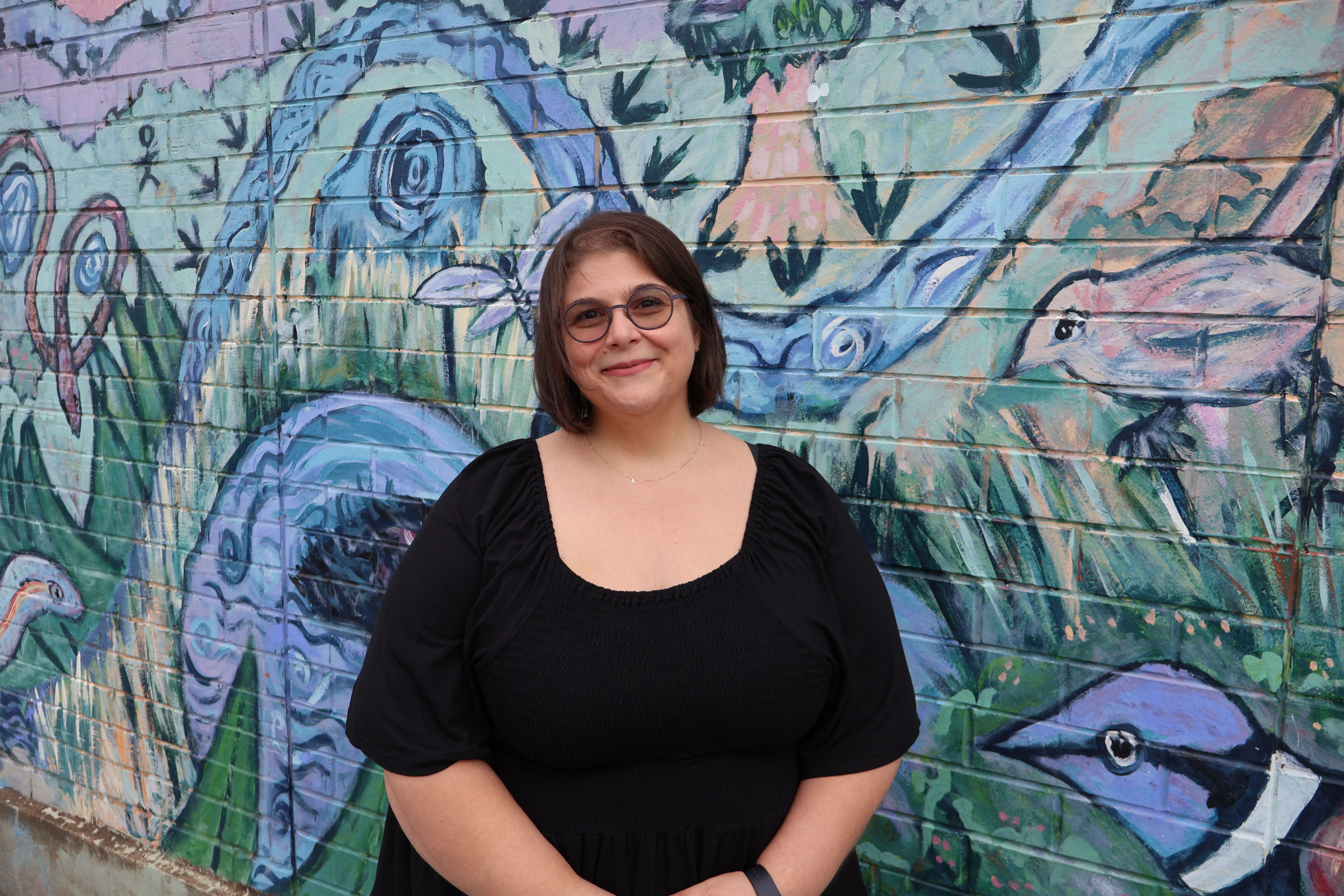
On the surface, 2022 looked like any other year for Adele – shows booked, dinners planned, a busy working life and a social calendar bursting at the seams. Then one otherwise ordinary night while meeting a friend for dinner, life threw her an unexpected curveball.
Adelaide's vibrant music, arts and culture scene is Adele’s perfect playground. Spending much of her free time catching up with friends or discovering the city’s dining spots, she thrives on a good conversation – and good food. At home, she doesn’t have it easy, with her five chaotic cats keeping her on her toes.
“They are work, and it’s hard, but I am rewarded with love, friendship and one walking all over me at 5am,” she laughs.
As a trained optical dispenser, Adele had spent much of her working life spotting problems others had missed and finding solutions for those experiencing visual difficulties. So, when she began noticing some unusual issues with her own eyes during a work course in late 2022, she did what came naturally – she rationalised it. Convinced she was overthinking things, she returned to work and, out of curiosity, asked her boss Kate to run a few tests.
“With calmness on the outside and, what I imagine as chaos on the inside, Kate told me she was sending me to hospital as it appeared I'd had a stroke,” Adele remembers.
After a CT scan and an array of tests, the doctors had their answer – an atypical migraine. Adele was sent home, but the number of strange symptoms didn't subside, if anything, the list continued to grow.
Deep down, she knew something was wrong but was struggling to voice her concern. Determined to carry on as normal, on one ordinary Friday night, Adele had just parked to meet her friend for dinner at a neighbouring restaurant. Stepping out of her car, she felt the sudden and terrifying sensation of the entire right side of her body spasm and stop functioning. She fell against the car, unable to speak, immediately panicking. Looking toward a nearby shop, she desperately hoped someone would notice her and come to help.
“I just stood there thinking, I'm going to die.”
Confused and terrified, she laughs now at her internal monologue in that moment – go to dinner or the hospital?
As many people living with a neurological condition experience, the road from first symptoms to a clear diagnosis is rarely linear. For Adele, it was no different. When she was eventually referred to a neurologist and her MRI results were reviewed, the multiple lesions on her brain and spine left little room for doubt. It was multiple sclerosis.
“The diagnosis had my head all over the place. I thought I’d lose my independence.”
Adele connected with the MS Society SA & NT almost immediately after diagnosis. Initially using Neurological Nursing support and Physiotherapy, she describes their invaluable help in an uncertain time. For Adele, knowing she could pick up the phone and hear a supportive, knowledgeable voice on the other end of the line made all the difference.
"I just used to call and say, 'hey, I have this problem – what do I do?'" she laughs.
“I remember a Nurse saying to me – I’m going to give you the good, bad and the ugly of MS. It might happen. It might not happen. But at least you’re prepared.”
It was a confronting conversation but for Adele, who had spent weeks hyper fixating on the worst-case scenario, that honesty was something she really valued.
And the support went beyond just practical advice. “The team understands. People look at me and think there's nothing wrong with her, but they see deeper.”
It's a sentiment echoed by MS Society SA & NT Physiotherapist Evan, who has been by Adele's side since the very beginning and has guided her rehabilitation both mentally and physically.
“I have seen Adele since she was diagnosed,” Evan explained.
“She has been through the whole journey – from the catastrophic: the sudden onset of symptoms, an ED visit, and the devastating news of brain lesions and an incurable diagnosis – to someone who is back at work, seeing the positives in life, staying physically active, and has had little MS progression since diagnosis.”
He explains how having the specialised MS support is critical.
“We can take each person's individual situation, both their medical but also the greater psychosocial situation, and help them move through the process of diagnosis.”
"The way MS constantly shifts and varies is what makes it so complex. The symptoms can be subtle – sometimes even difficult for Clients themselves to verbalise – but there are trends and tendencies in the way they present that looks quite different from the same symptom in another condition.”
“If you don't work with enough people with MS, you simply don't see those patterns,” Evan explains.
Having the right support and services in her corner lifted the mental burden of navigating where to turn for help – the team working as a lighthouse amidst all the uncertainty. However, when the MS Society fell into administration in late 2025, Adele recalls that familiar unsettling feeling resurfacing after hearing the news.
“I wouldn’t know what to do without the MS Society,” she states.
“When they went into administration I fell into a deep pit. It felt like being diagnosed all over again.”
Now working with sister society MSWA to reshape and rebuild the MS Society SA & NT so that Clients in SA and the NT can receive the neurological support they need and deserve, Adele reiterates the importance of a service that will stay with you for years to come as life, and the condition, inevitably progresses.
“I think I'm lucky,” she smiles.
“When I was diagnosed, I was just terrified. But because of the medication and the changes to treatment over the last 10-20 years, I don't have those same symptoms that I had when I was diagnosed.”
“It’s just made me appreciate life and the people who love me.”
No longer working as an optical dispenser, Adele’s chatty disposition has now found its perfect match in her role as a receptionist in an Oncology Clinic – often consoling those going through a journey not too dissimilar from herself. Outside of work, she’s never one to watch life from the nosebleeds, instead, she’s always going to be front and centre – especially when there is dancing involved. When she looks back on the tumultuous last few years, her advice to the newly diagnosed is simple.
“Be gentle with yourself. Find the right support for you.”
“But start with the MS Society. They are everything I could have needed.”